Anywhere Real Estate, now Compass Intl. Holdings, is a parent company that owns some of the biggest real estate brands in the US.
I led the end-to-end design vision for a new consumer facing home-buying app on a team that was going through their own growing pains and ops challenges.
The ultimate goal was to help customers find, understand and manage the entire home-buying process on their phone.
↓ Check out the nerdy details below ↓
Sr. Product Designer & Lead
April 2024
User Research, UX Design, Prototyping, Testing, Storytelling
Product manager, Lead engineer, UX Researcher, UX designer
When I joined the project, the team was already working on an MVP focused on home search. The design files were organized around individual Jira tickets rather than end-to-end user journeys.
The work had not yet been reviewed with product or engineering. The design team was early in their careers, business goals were still being defined, and engineering had little experience partnering closely with UX. This created an opportunity for me to bring more structure and alignment to the design process, and my role quickly evolved from contributor to design lead.
Later, I was tasked to define the future direction of the product to inform the company’s strategic roadmap. I’ll share how I introduced clearer UX processes and led the development of a blue-sky concept that became a key strategic opportunity for Anywhere and a foundation for future growth.
Role & Challenge:
At the start of the project, a lot of MVP features had already been designed in high-fidelity while product goals, success metrics, and tech alignment were still being defined. Designs were frequently revisited and adjusted. This created additional coordination across design, product, and engineering as we worked to align on a shared direction.
The scope of my role shifted as this project moved forward. I was responsible for bringing clarity, structure, and vision to a product that had been moving quickly but without UX foundations. I partnered closely with product and engineering leads, UX research, design leadership, and two other designers to realign the MVP into a unified experience, while also mentoring the designers on the team.
After stabilizing the work and gaining trust with my cross-functional partners, I devloped a blue-sky concept to serve as a north star for the future of this product. But more on that later.
Process:
I reviewed the work that had been done and the items set in Jira. I met individually with my cross-functional partners to learn more about what they were trying to accomplish and what success would look like for them.
Then I built out a template to start organizing screens in end-to-end flows and use cases. These templates eventually became part of the Anywhere UX team’s design process.
I reconstructed the file organizing it in end-to-end flows, adding logic annotations to save time in grooming sessions, and identifying missing use cases. This helped clarify what we needed to fix. Scoping the work became easier and helped us have more accurate timelines. As well as aligning and giving visibility to our partners.
I facilitated working sessions with product and engineering to help them think in journeys instead of tickets. I also established a cadence of design reviews and led conversations that helped improved communication.
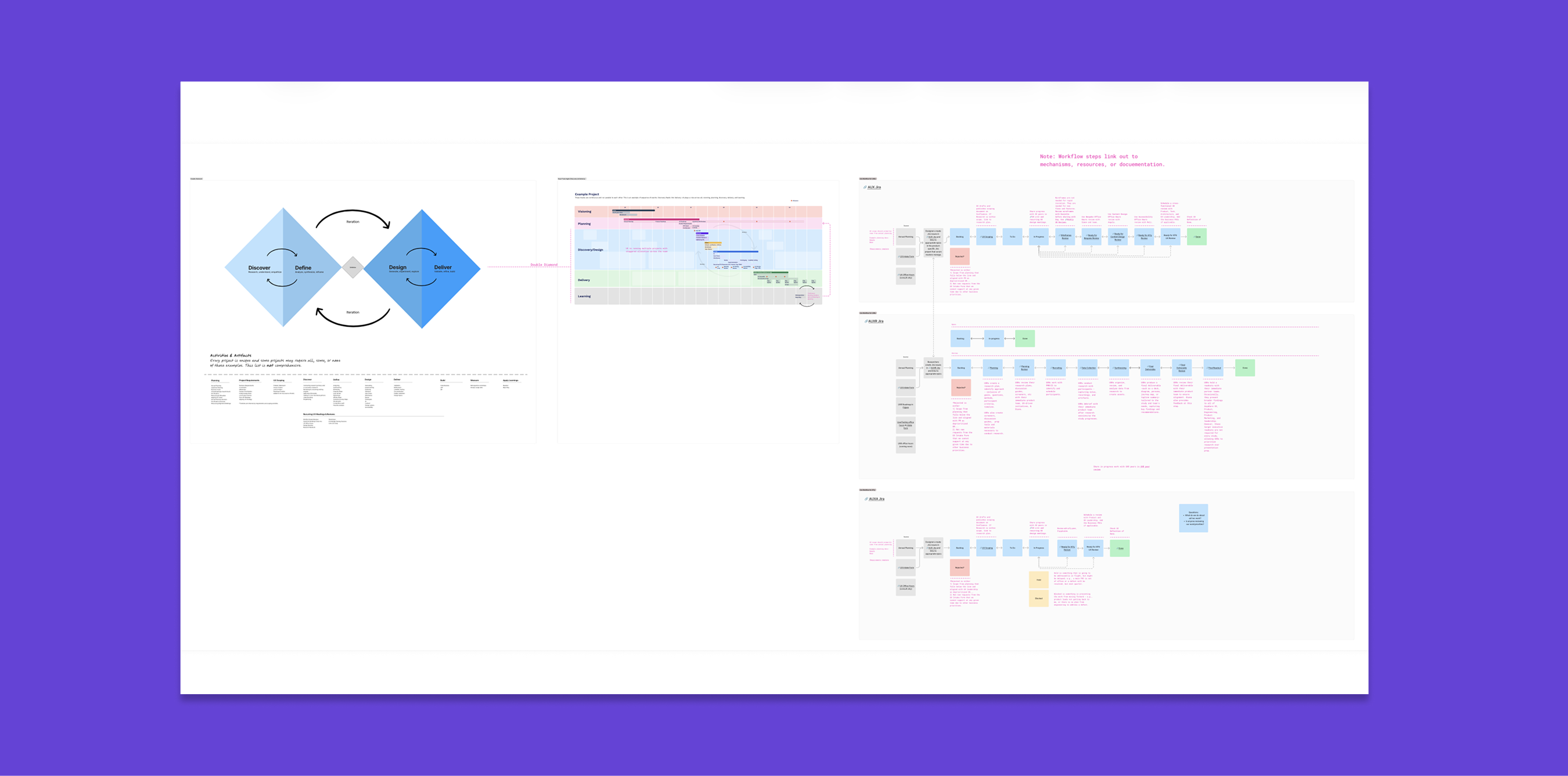
Image intentionally blurred to protect confidential project details.
Research & Insights:
Now that we had more stability in the day-to-day work, I wanted to validate that we building the right thing. I partnered with a UX researcher and ran a study to validate features and content as well as the overall use of the app.
Results were mostly positive and feedback we received helped us improve the experience.
9 of 10 users said the overall app felt clear and easy to follow
8 of 10 were able to complete all tasks without guidance
10 of 10 understood how to save a home
6 of 10 wanted more clarity around fees, property taxes, and neighborhoods
8 of 10 users said the content presented was enough to take the next step
9 of 10 said they would use the app again
Design strategy:
As the work for the MVP kept going, the VP of UX reached out. I was tasked to start thinking about the future and come up with a blue-sky concept we could test so we could provide the business and the product team with insights into where we should go next.
I started exploring and researching the home-buying process. I realized the closing process is a black box. Buyers feel anxious, uninformed, and afraid of missing something.
I asked for all of our research we had previously done in the past 2 years on the closing process to understand common pain points. The same insight surfaced: People described the experience as stressful, confusing, lacking visibility, and a dependency on their agent.
This insight became the foundation of the vision I wanted to build and test.
“You just hope you have a good agent that will keep you up-to-date on anything you need to do before closing”
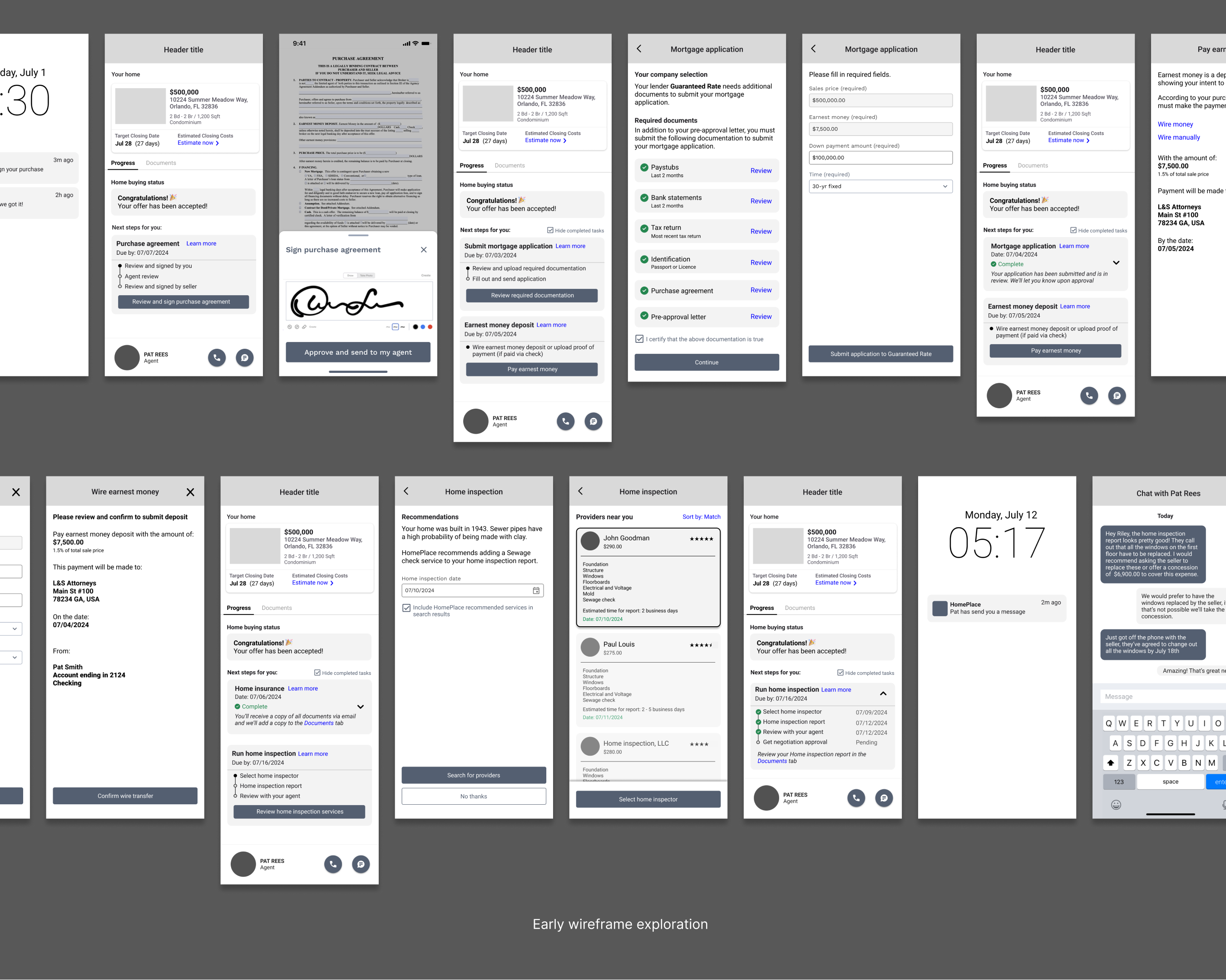
I pulled together some wireframes to keep the focus on content and logic. My goal was to get answers to these questions: Would consumers value visibility into the closing process, or prefer to rely on their agent? and Would consumers trust us if we leverage AI and ML to help with this process?
I teamed up with our UX researcher and another designer on my team to build a low-fidelity prototype that walked buyers through a mobile-first closing experience.
I wanted the experience to feel clear and simple. Every step was grounded in real estate industry workflows.
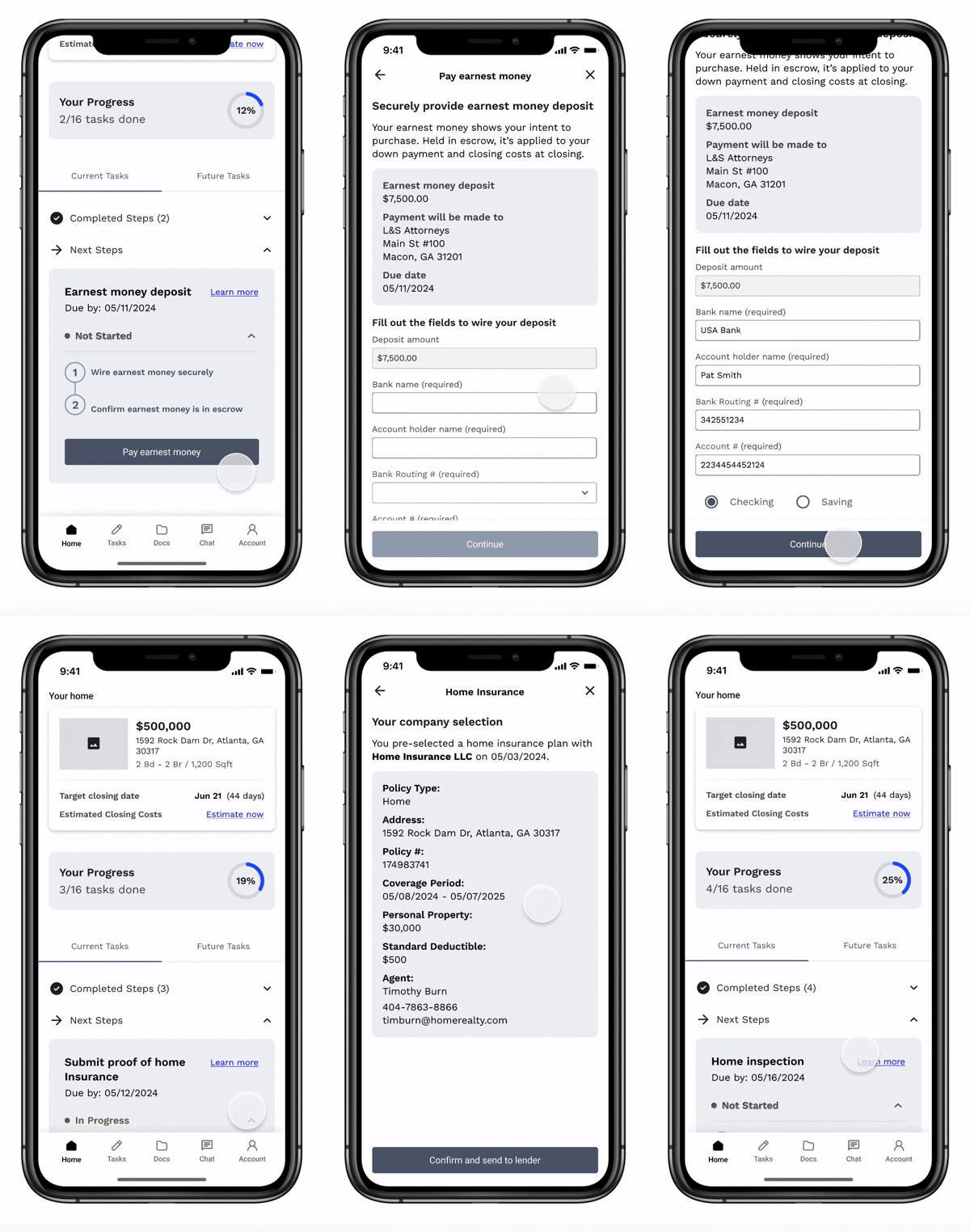
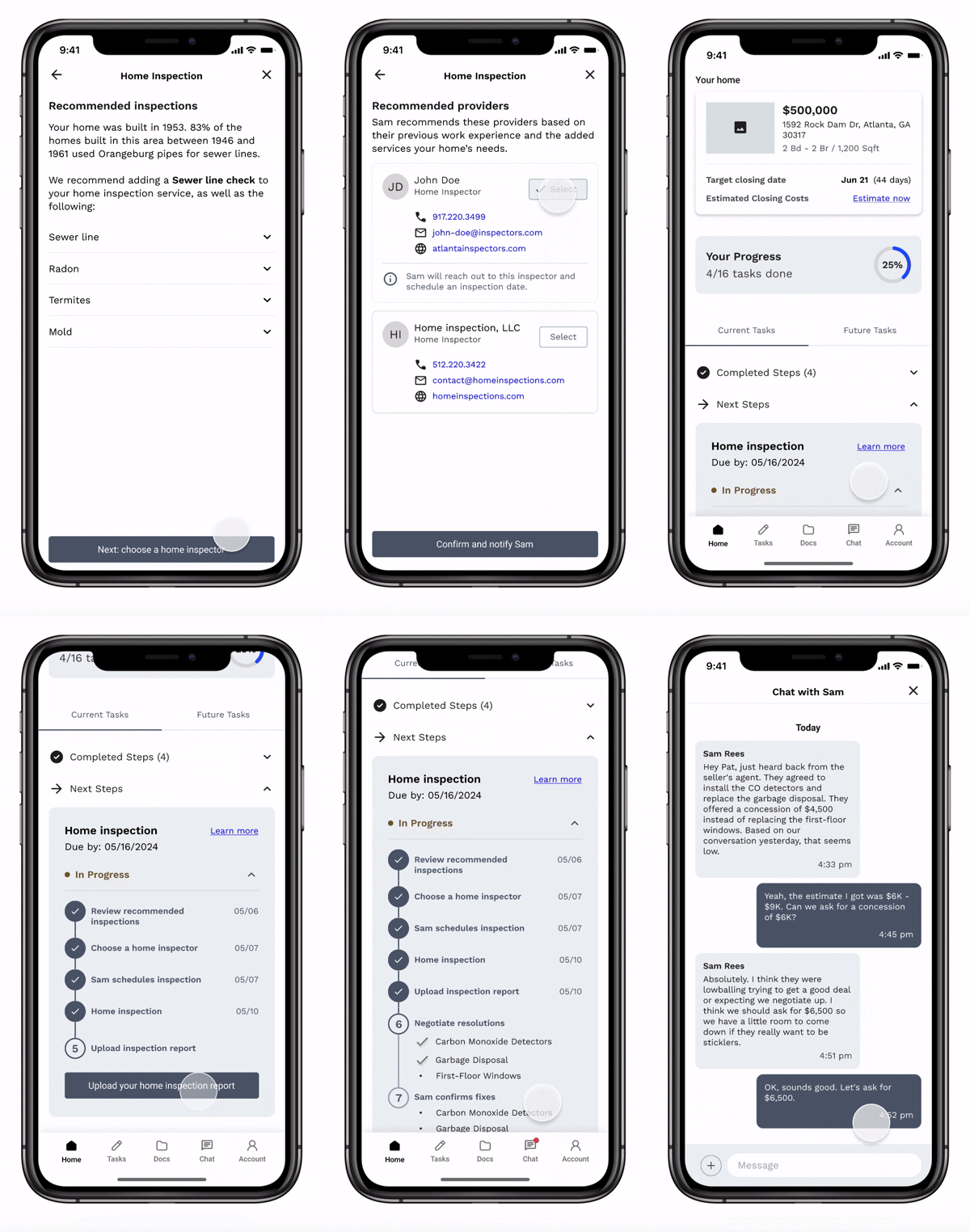
I mapped out the steps you go through when buying a home, like signing purchase agreements, making earnest money payments, tracking deadlines, and staying in touch with your agent. I included AI touchpoints that gave consumers insights based on the home they were purchasing.
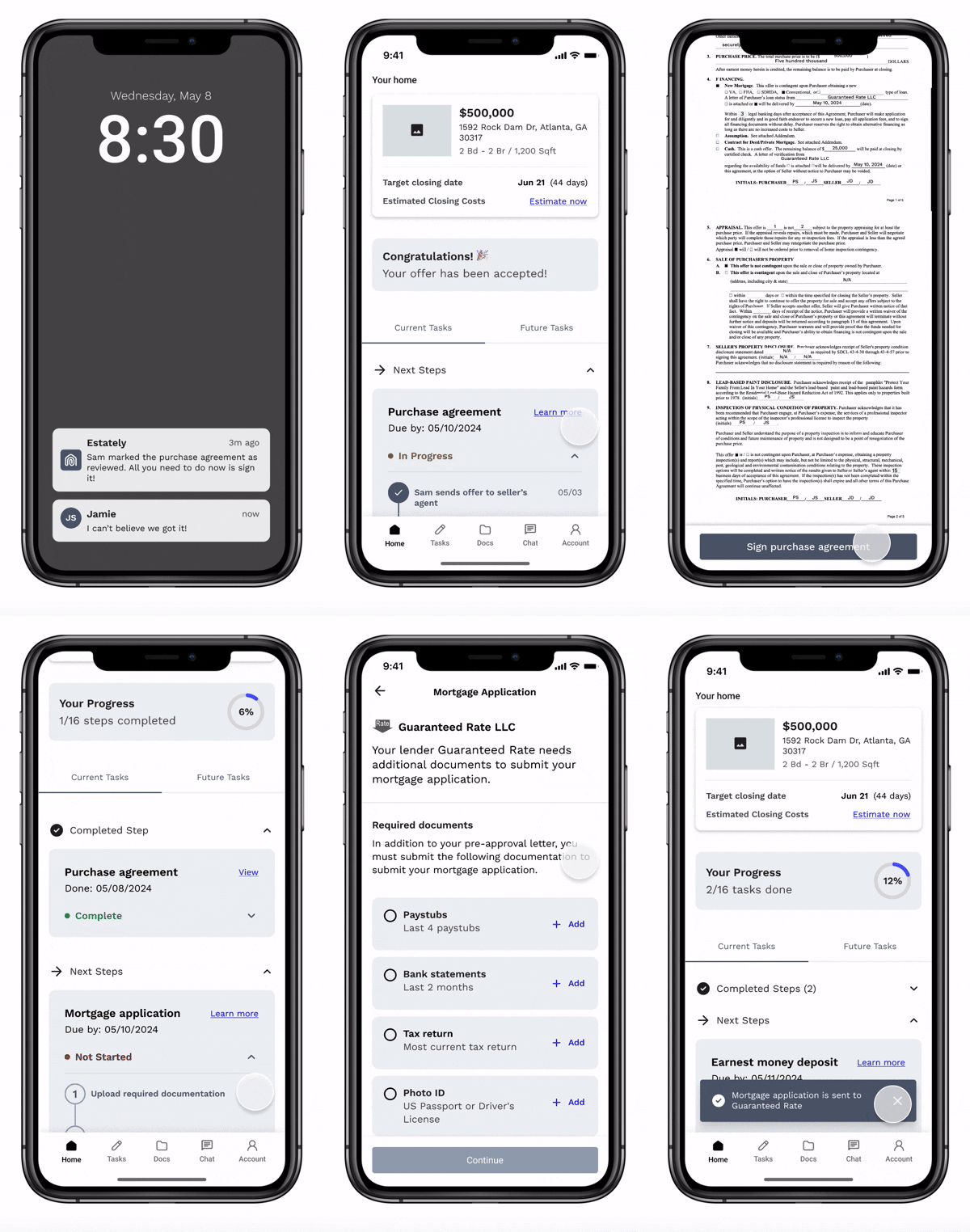
Sign and submit documentation
Pay earnest money
Get quick agent support
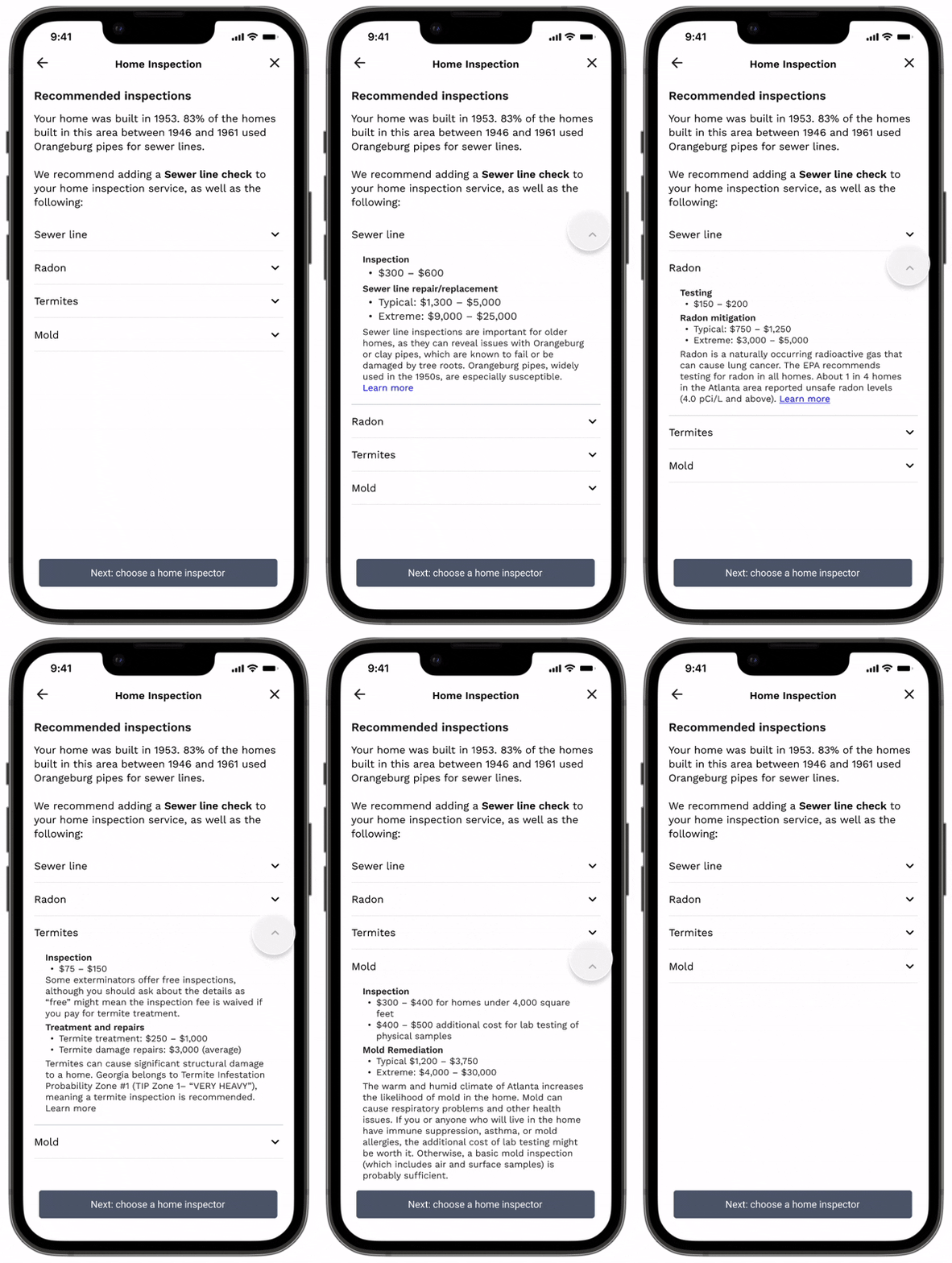
I’ve been working with AI and ML concepts since 2018, and for this particular use case, I made sure to be intentional about how I used it to enhance the flow and genuinely help buyers feel condifent and informed.
For example, we could surface insights that may need special inspections like properties in seismic zones that might require foundation checks, or MLS and public data that reveal patterns worth paying attention to.
Testing & Iteration:
We tested the prototype with 13 participants, a mix of recent buyers, first-time buyers, and active shoppers. The reactions were positive.
“Wow, I wish this would’ve existed last year when my wife and I bought our house.”
“I love how clear and helpful this is. It's would be like someone guiding me through this process.”
Participants expressed relief and excitement at the idea of having visibility into the closing process.
Our research validated the product’s strategic direction and secured executive buy-in.
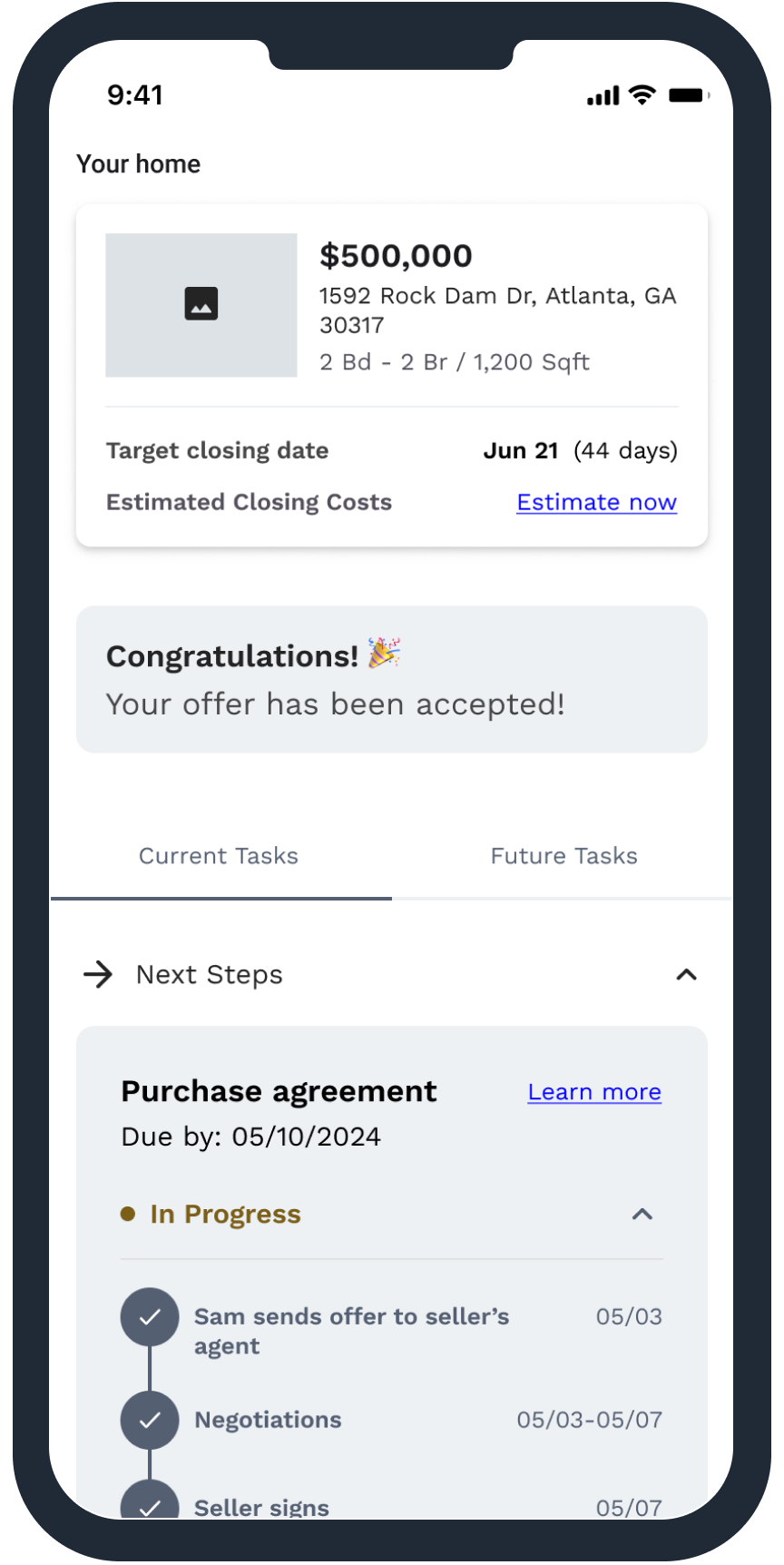
Following this, Anywhere approved the initiative and formed a dedicated team to build the vision. I led the team, and a designer I managed developed the initial mocks (shown below) that launched in mid-2025.
As the work came together, the MVP took shape making it clear and showed the importance of proper documentation. This gave engineering the clarity they needed to move faster and helped cut down on rework that had been burning out designers and slowing the project down for months.
Product partners also began to shift their thinking. From isolated tickets to full user flows and understanding the needs behind them.
The blue-sky concept also made its way to the executive team and shaped the company’s future roadmap.
There was also impact within the Anywhere UX team. Introducing templates, mechanisims and workflows that became part of the formal UX process. This helped designers who were early in their careers grow under structure and mentorship. It helped strenghten collaboration with product and engineering as they began to trust UX as a strategic partner.
The project also had a major effect on my own path. I was promoted to Design manager, where I lead three consumer product teams along with the design initiatives team. One of those teams is responsible for bringing this vision to market, which feels like a full-circle moment that all started with a simple blue-sky prototype.
Looking back, this project was never only about the screens we designed. It was about creating clarity in an environment that had none, building UX maturity from the ground up, and shaping a vision that centered real customer needs.
By supporting the present while imagining the future, we helped create both the foundation and the ambition for a product that could change how people buy homes. That impact, both for the organization and for the customers we designed for, is something I am deeply proud of.
To comply with my non-disclosure agreement, I have omitted and/or blurred confidential information. All of this case study's material is copyrighted and property of Compass Intl. Holdings.
Life moves pretty fast, if you don't stop and look around once in a while, you could miss it
Thanks for stopping by
Have some fun