This initative was part of leadership’s long-term strategy roadmap.
It required a unified experience that felt consistent across regions while remaining culturally relevant and true to the Prime brand.
For this case study, I’ll highlight 5 of the projects from this initative.
↓ Check out the nerdy details below ↓
Sr. UX Designer
October 2023
User research, UX design, UI design, Prototyping, User testing, Storytelling
Sr. Technical PM, Sr. Manager of product, Sr. Software engineer.
At Prime Worldwide, my area of ownership was Onboarding & Acquisitions. I realized that the onboarding experience for Prime was lacking. Working closely with cross-functional partners (PMs and engineers) we decided we needed to craft a complete onboarding experience and strategy.
This onboarding strategy was to address the fact that a large percentage of customers cancelled their memberships within the first 60 days. Most users subscribed for the free delivery benefit and didn’t realize their membership included a lot more value and additional perks.
Our goal was to reduce churn, increase engagement across other benefits, and create a scalable onboarding experience that could adapt to different countries and markets.
Role & Challenge:
I led the end-to-end UX design for this work, partnering closely with a Senior Technical Product Manager, Senior Manager of Product, Senior Software Engineer, and several product managers across different global markets.
The overall strategy spanned 12-18 months, with ten smaller projects delivered in 3-12 week cycles, depending on the requirements and size of the project.
Before, customers were welcomed to Prime with a single welcome email that didn’t explain the full membership benefits, and lacked engagement.
As a team, we hypothesized that customers didn’t perceive the value of Prime because they didn’t understand what was included.
Business goals:
The team set out with a few goals in mind for a new or returning Prime member’s first 60 days. Increase engagement and exploration of Prime benefits while also, reducing churn and cancellations, and improving satisfaction ratings. This also needed to scale across countries, languages, cultures, and different sets of available features and benefits.
Research & Insights:
To ground the strategy in real user needs, I compiled the customer feedback from Amazon’s research database, research conducted by the product team and UXR team, and different regional teams for market-specific insights.
Many customers were only interested in one benefit, fast and free delivery, and didn’t realize how much else was included in their membership. I met with teams in different markets to get more information on their metrics and pain points specific to their countries.
Design strategy:
With goals and research data in hand, I brainstormed ideas for a complete onboarding to Prime. I used those ideas as conversation starters and partnered closely with my PM to brainstoming together.
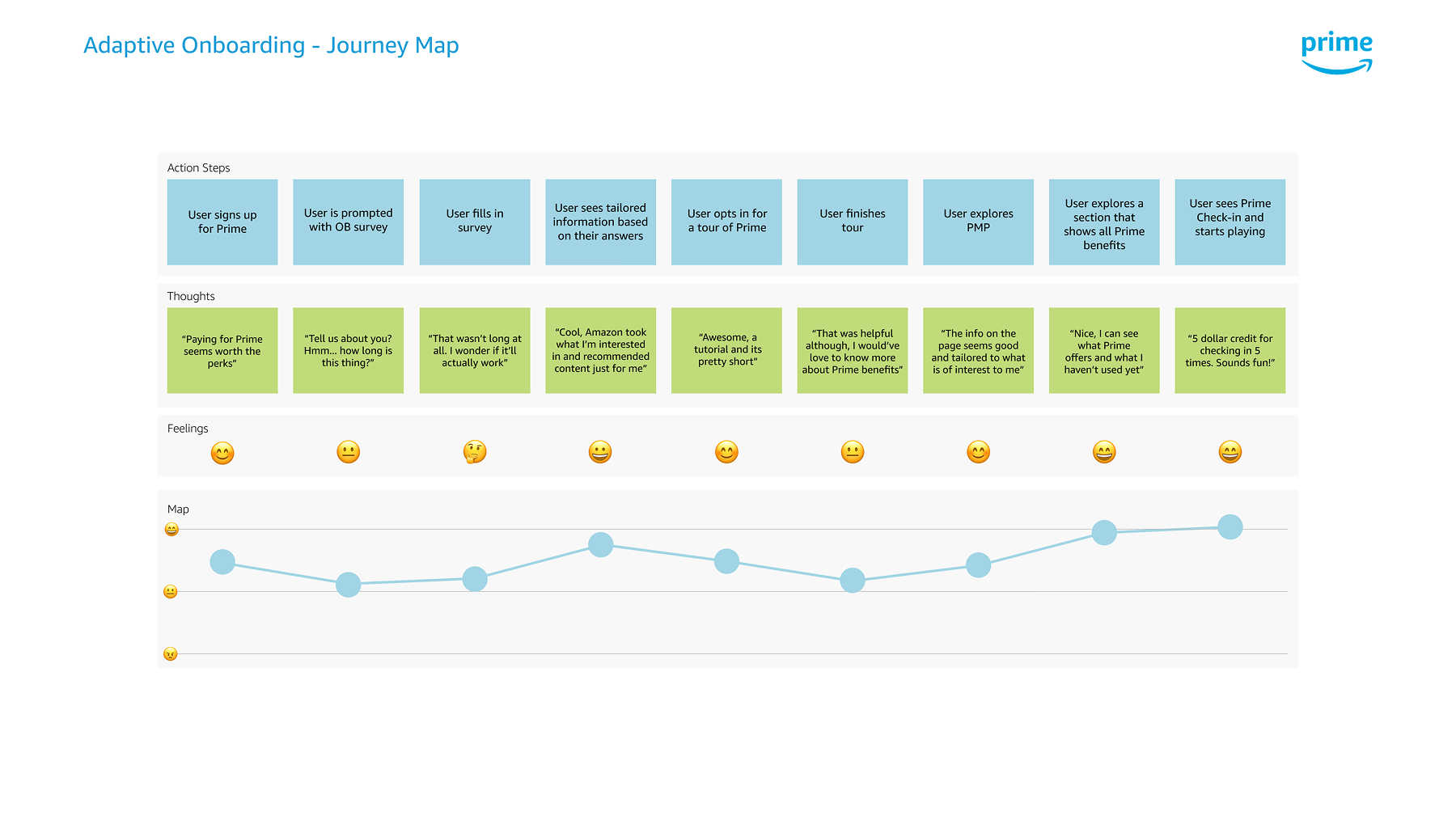
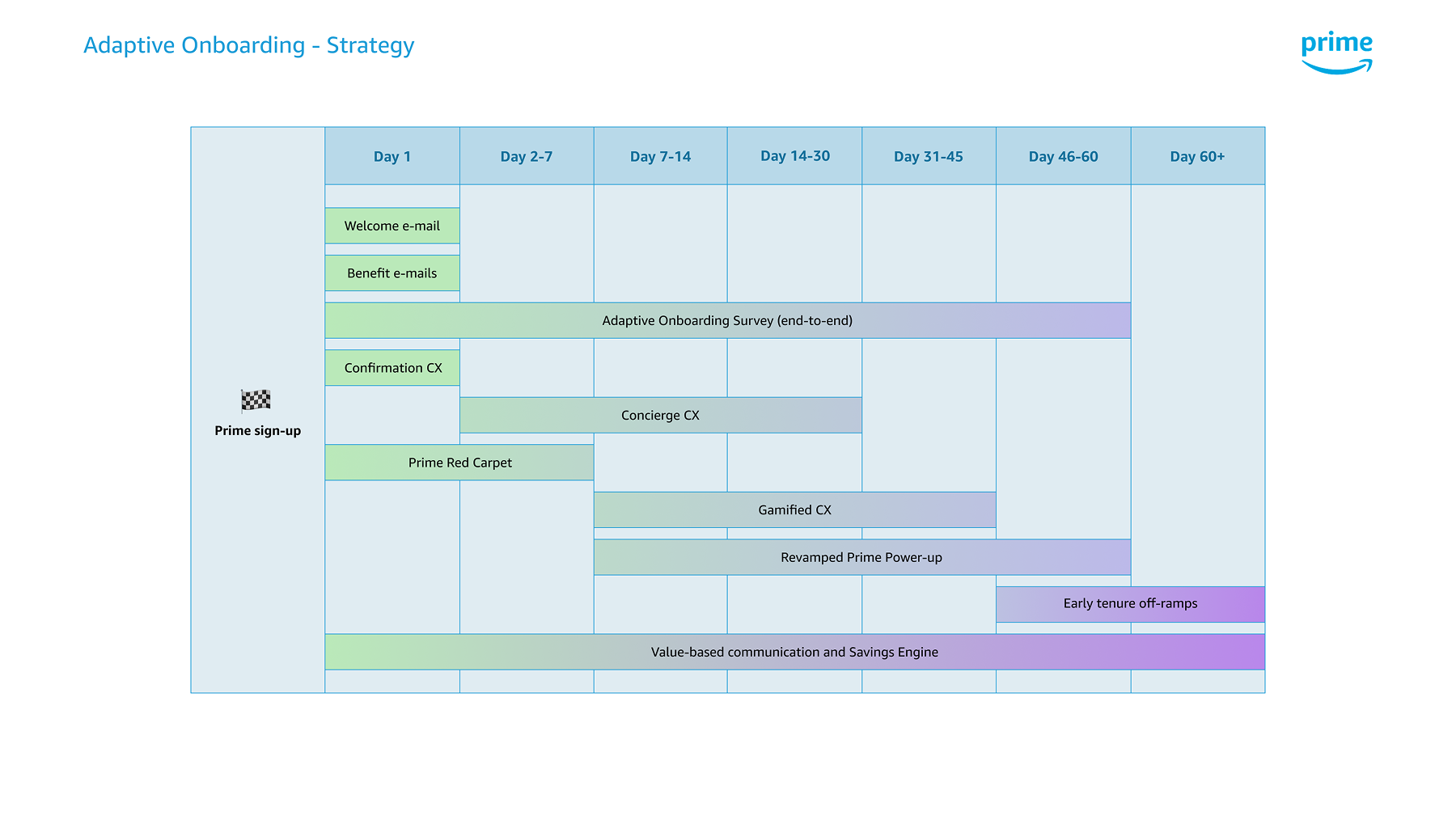
We came up with 10 touchpoints that would work as complementary experiences but that could also stand alone, solving for launches and markets. This shaped out the onboarding strategy
The Senior manager of product wanted to make sure we had leadership backup, so I created a storyboard to help tell the story. This helped us get leadership buy-in and also allowed us to gain alignment with other partners in different markets as well as making sure we were all moving in the same direction.
As a team we decided what would work best for which markets and where we would launch experiments first to see what we could tweak before a wider launch.
The design strategy was grounded in a hyper-personalized experience that leveraged AI and ML to show customers what they were interested in depending on their choices, engagement, orders, interests, etc.
Scalability & Localization:
Designing for multiple markets was a major challenge, and I knew the experience needed to feel relevant everywhere. To tackle this, I reviewed local research for each region, stayed in contact regularly with regional teams, and opted for illustrations over photographs to ensure universal appeal.
I prioritized designing in modular components that could be added to available placements throughout the Prime CX, making it easier to scale without breaking other parts of the user experience.
Accessibility standards were consulted on and approved throughout my design process. I leveraged Amazon’s consumer-facing design system extensively to ensure consistency and scalability.
Choosing which benefits to highlight and in what order required balancing user needs with business priorities. I relied heavily on research insights, focused on the most-used benefits, and aligned decisions with product leadership.
For this case study, I'm presenting 5 out of 10 touchpoints I worked on for this strategy.
Project 1:
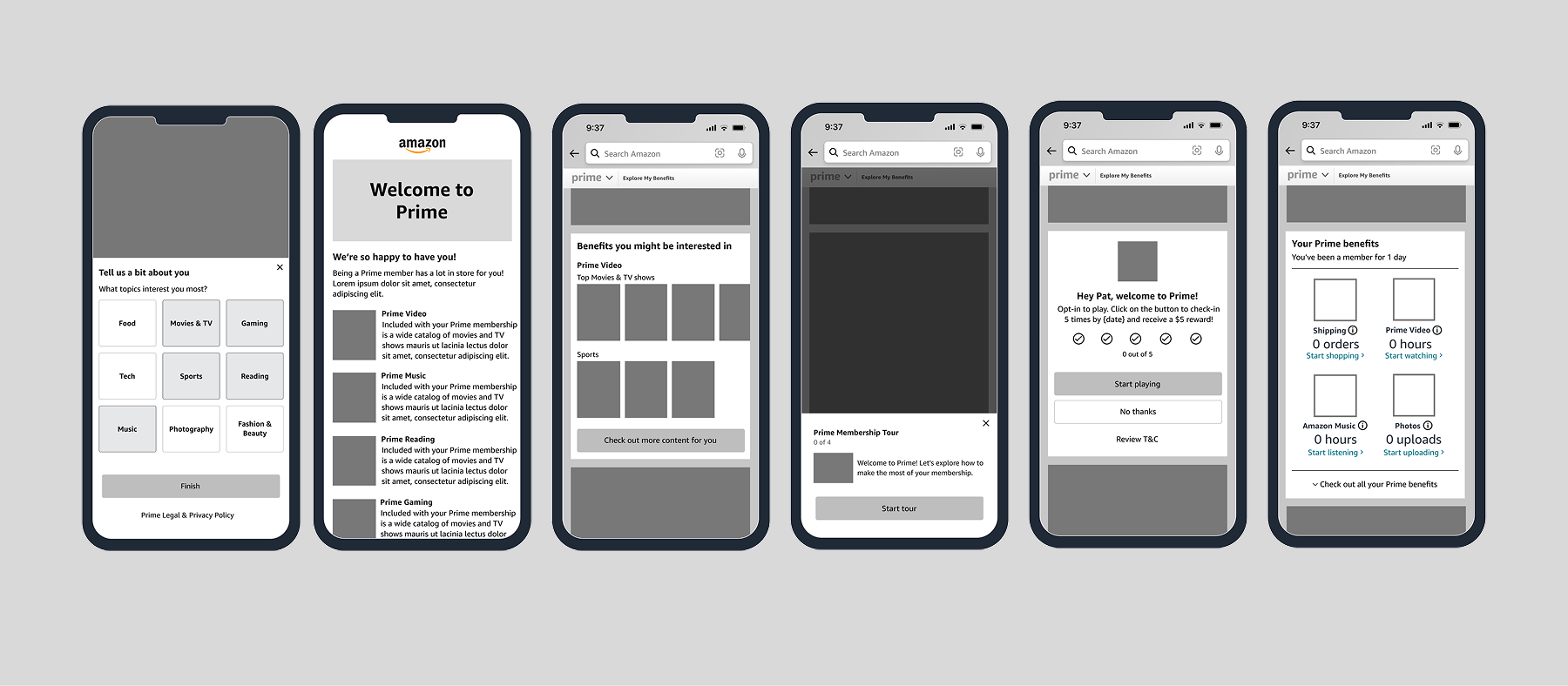
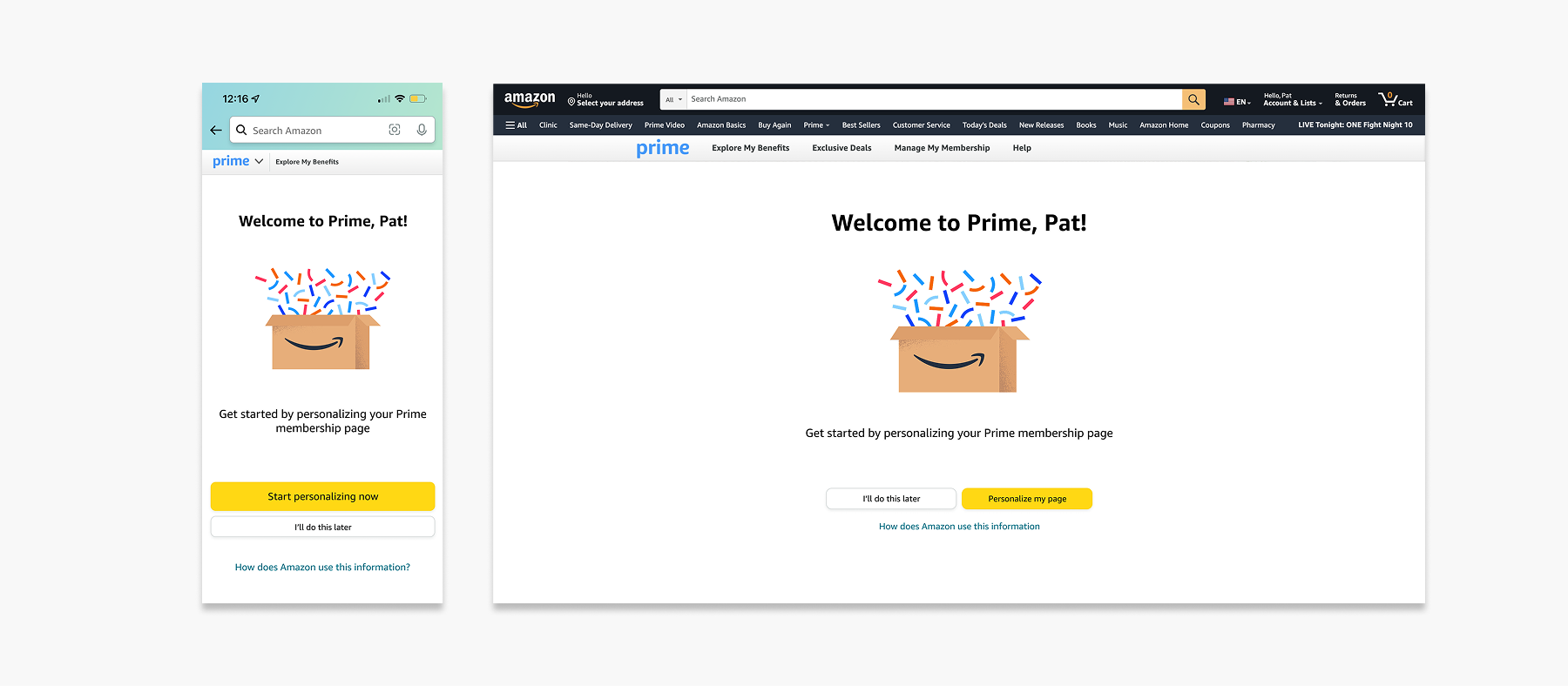
Adaptive onboarding survey
A quick assesment to learn more about our customer’s interests so we can tailor content for them.
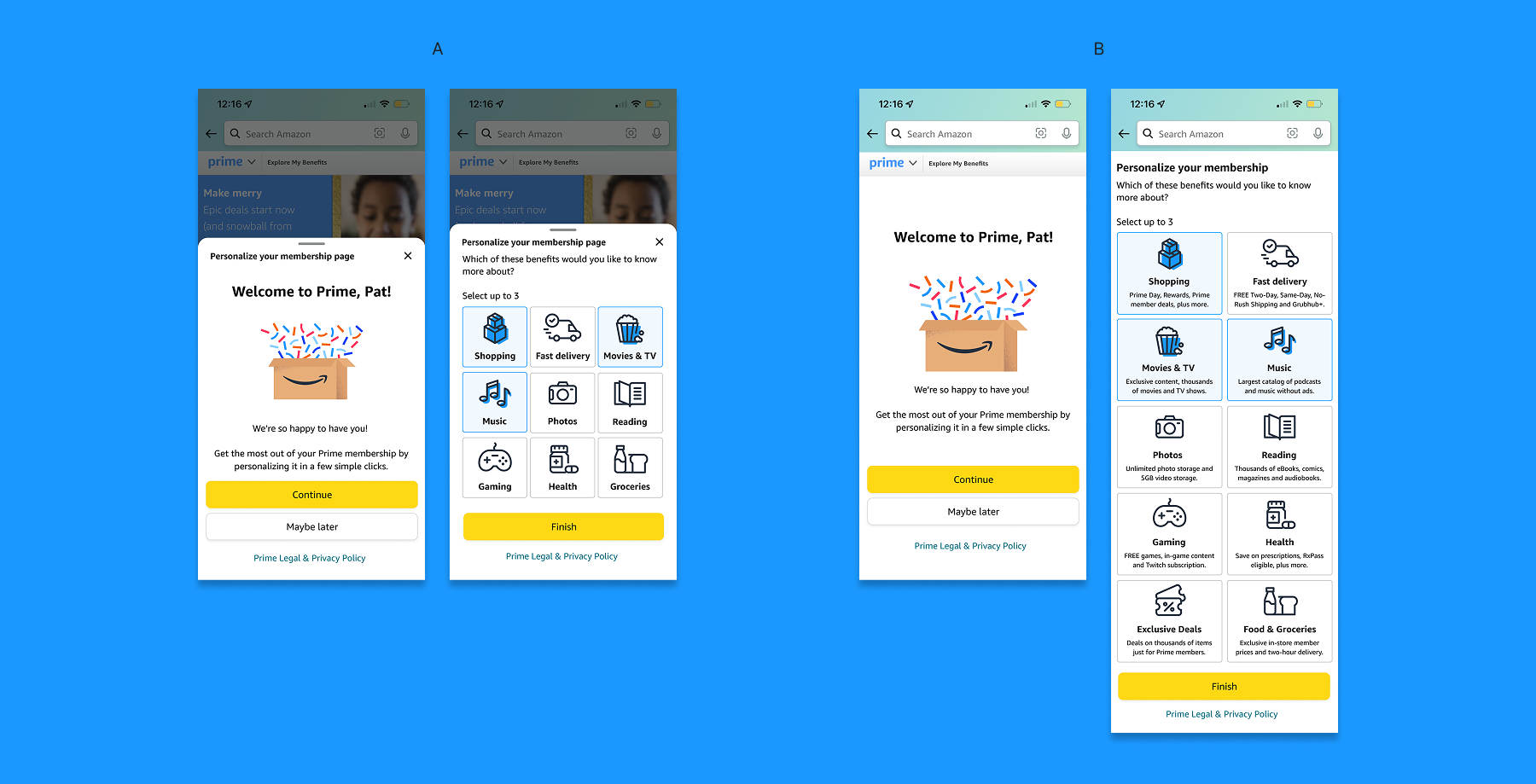
Experience A launched in select markets; Experience B launched in others, including the US
Project 2:
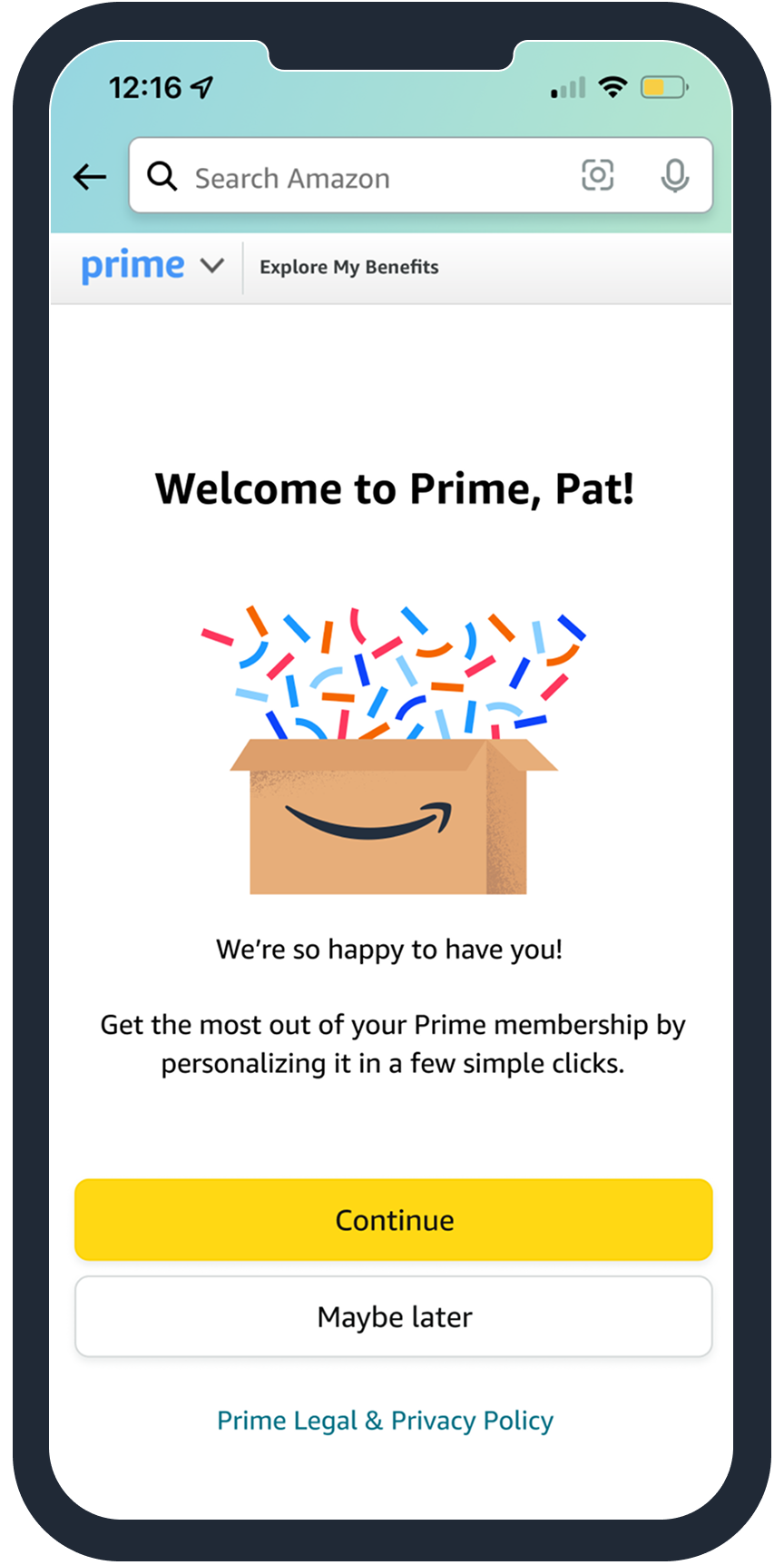
Prime onboarding messaging
A tailored messaging experience with different touchpoints throughout to welcome customers to Prime.

Tailored messaging for different cohorts
Project 3:
Prime tour
A short and easy-to-follow CX to help customers get familiar with Prime.
Project 4:
Prime benefits value tracker
A simple way to help customers see their benefit usage and increase visibility into membership value. Prime savings was later added to the experience.

Top Prime benefits prioritized using user feedback and data
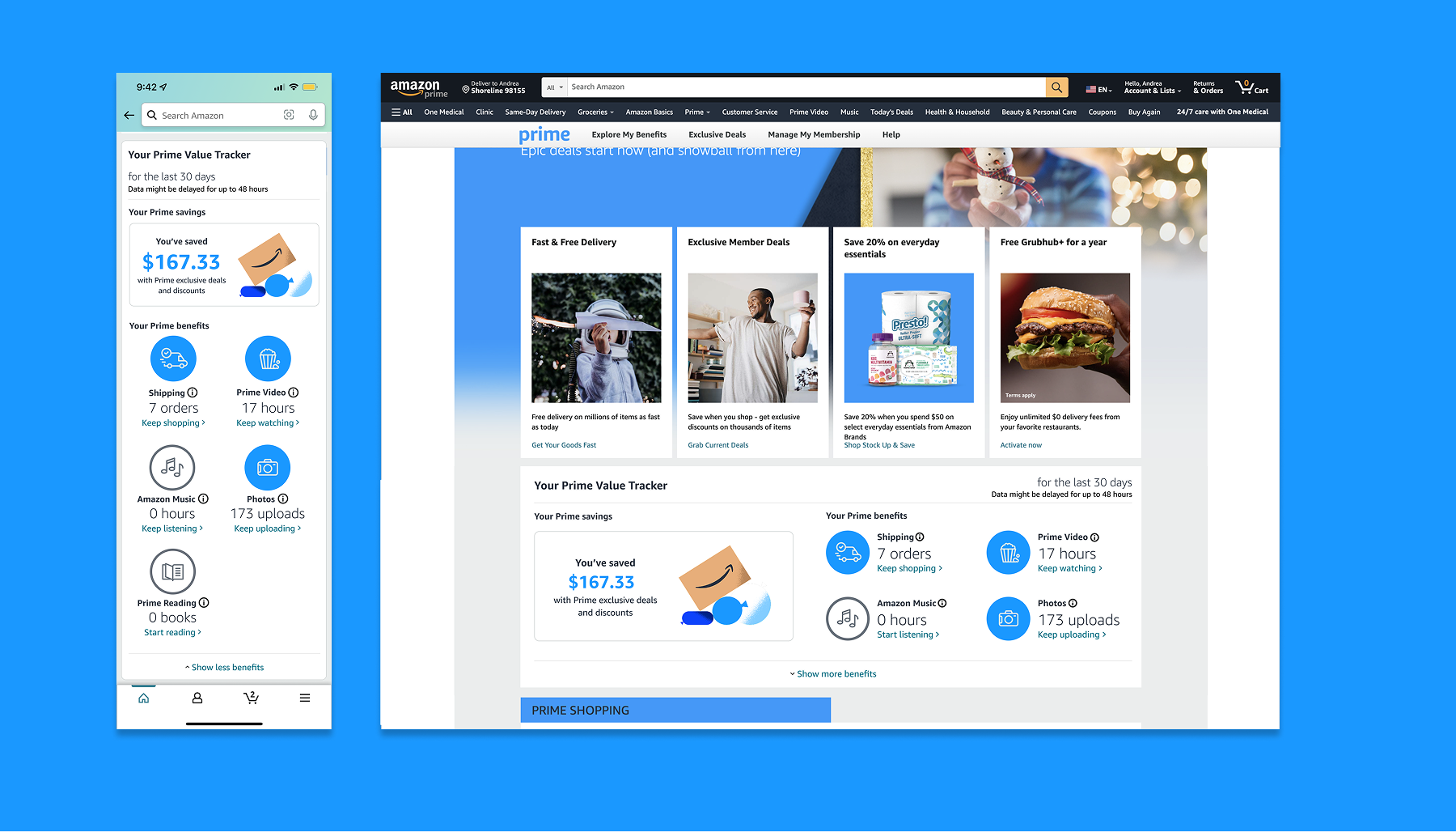
For P1 we introduced Prime Savings to highlight total savings
Project 5:
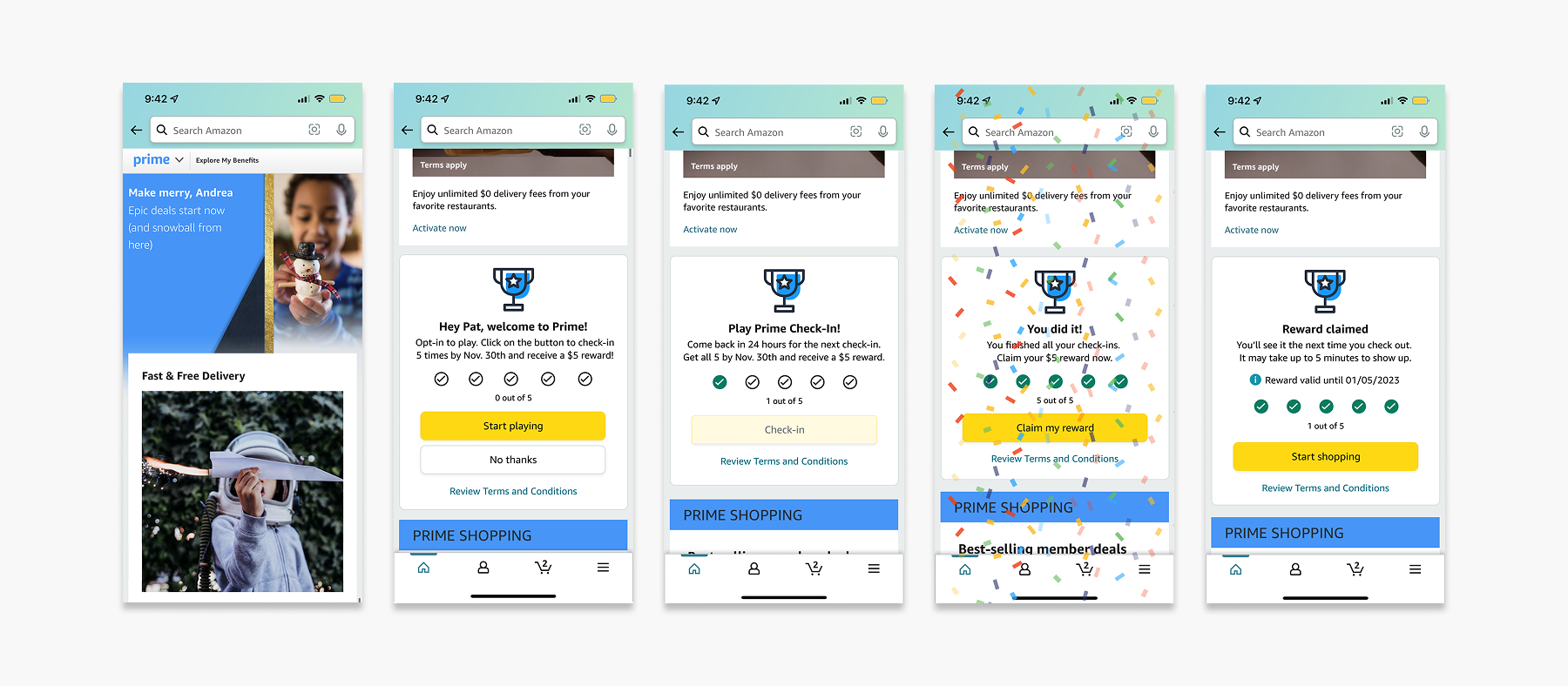
Prime Check-in
A gamification strategy to drive engagement so customers would get to know Prime better. Launched in the US and the UK. Metrics went above projected estimations.
I set up a cadence to stay aligned as a team: Design reviews, regular check-ins with P&E, and hands-on design thinking sessions when needed. We anchored decisions in research and data.
Each project had rounds of usability testing to validate flows, copy, and clarity, followed by fast iterations based on feedback.
Some projects required simplified designs due to technical trade-offs. Fast-follow improvements were added to the roadmap to make sure the long-term vision wasn’t compromised.
The launch delivered meaningful and measurable results, validating both the strategy and the execution. From a quantitative standpoint, the experience exceeded expectations across key metrics:
37% decrease in churn against a 15% goal
22% increase in engagement with membership benefits
17% increase in traffic to the membership landing page
27% decrease in membership cancellations
Beyond the numbers, the qualitative feedback reinforced that we were solving the right problems. During testing, users described the experience as “simple”, “clear”, and “intuitive”, and many shared that they were discovering benefits they had not previously known existed. Regional teams echoed this sentiment and confirmed that the experience met or exceeded their local goals.
The impact extended beyond the product itself and into how the organization worked. I introduced mechanisms that improved cross-functional alignment and helped teams stay focused as the initiative scaled. Storyboards played a key role in creating early clarity and a shared vision, allowing partners across product, engineering, and regional teams to align quickly. As we learned from each launch, fast-follow improvements were added to the roadmap to support long-term scaling without losing momentum.
Contributing to an initiative that improved the experience for more than 200 million members worldwide was especially rewarding. Seeing the work shift both perception and behavior at such scale reinforced the value of thoughtful, research-driven design.
Many of the onboarding improvements have since become part of the standard experience, adapted by locale. While I left the company as results were still being socialized, the early performance made a strong case for continued investment and long-term impact.
To comply with my non-disclosure agreement, I have omitted and/or blurred confidential information. All of this case study's material is copyrighted and property of Amazon.
Life moves pretty fast, if you don't stop and look around once in a while, you could miss it
Thanks for stopping by
Have some fun